
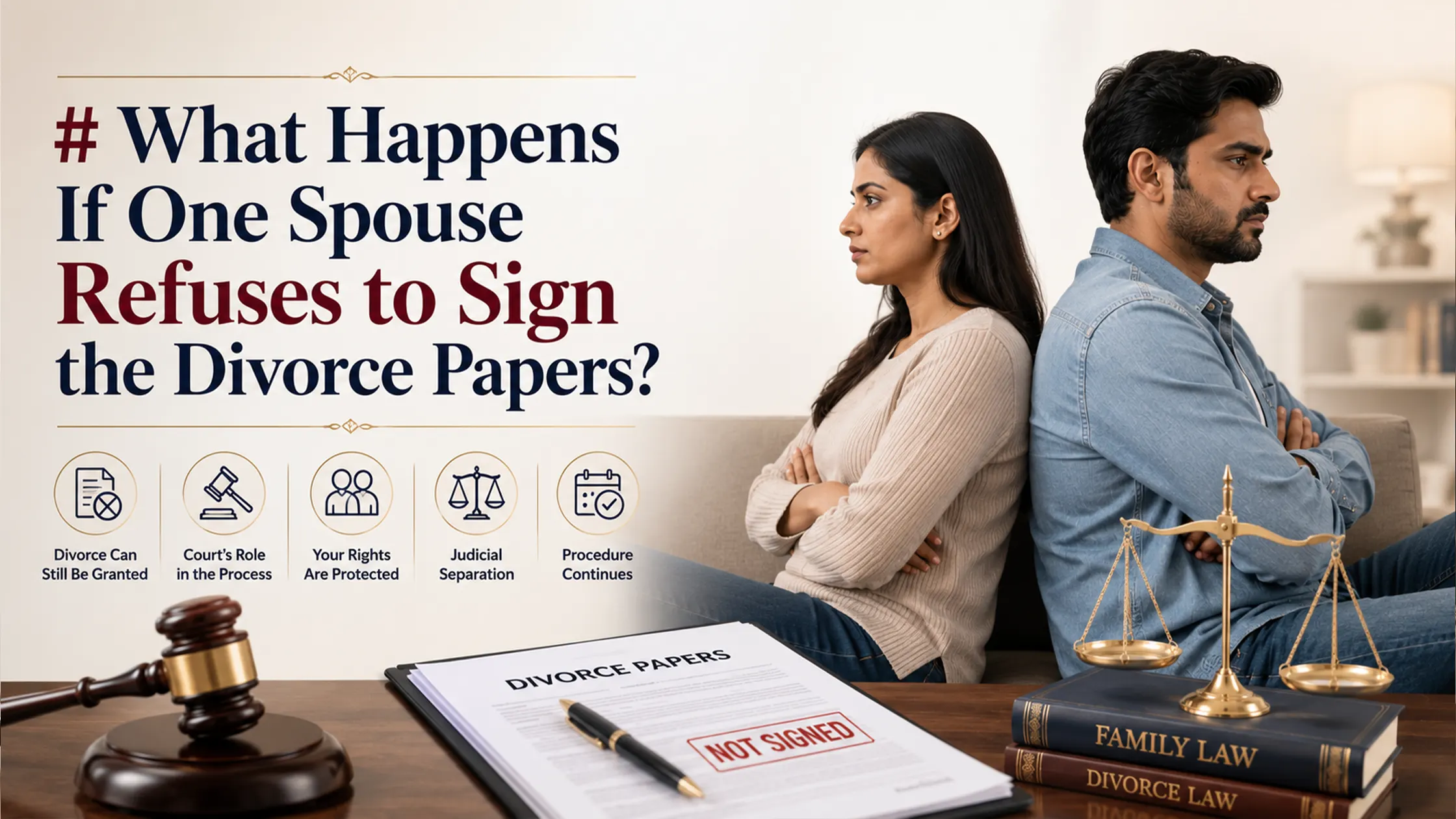
One of the most common questions people ask when going through a difficult marriage is:
“What if my spouse simply refuses to sign the divorce papers?”
It can be frustrating, especially when you’ve already decided that you want to end the marriage and your spouse isn’t willing to cooperate.
The good news is that one spouse’s refusal to sign does not necessarily mean that you can never get a divorce.
However, what happens next depends on the type of divorce you are seeking.
If both spouses agree to end the marriage, they may be able to pursue a mutual consent divorce. But if one spouse refuses to agree, the situation generally becomes a contested divorce, where the spouse seeking divorce has to proceed under the applicable law and establish legally recognised grounds.
If you’re facing this situation in Bangalore, understanding the difference between these two routes can make the situation much clearer.
Can One Spouse Refuse to Give a Divorce?
Yes, a spouse can refuse to agree to a mutual consent divorce.
Mutual consent means exactly what it sounds like—both spouses must agree to end the marriage and comply with the applicable legal requirements.
So if your spouse says:
“I won’t sign.”
you generally cannot force them to participate in a mutual consent divorce.
But that doesn’t necessarily give them the power to prevent divorce forever.
If legally recognised grounds for divorce exist, the spouse who wants the divorce may be able to file a contested divorce petition.
What Is the Difference Between Mutual and Contested Divorce?
Understanding this distinction is important.
Mutual Consent Divorce
In a mutual consent divorce, both spouses agree that the marriage should end.
They may also agree on issues such as:
- Maintenance or alimony
- Child custody
- Parenting arrangements
- Property
- Personal belongings
- Financial responsibilities
- Other settlement terms
Because both parties are cooperating, the process can generally be less contentious.
But if one spouse changes their mind or refuses to consent, the mutual consent route may not be available in the same way.
Contested Divorce
A contested divorce is different.
Here, one spouse wants the divorce, but the other spouse does not agree or disputes the grounds or other issues.
The spouse seeking divorce can approach the court and rely on a legally recognised ground under the applicable law.
The court then considers the evidence and arguments before deciding the matter.
So, your spouse refusing to sign does not automatically end your ability to seek divorce.
What If My Spouse Says, “I Will Never Give You a Divorce”?
This can sound frightening, but it’s important to understand what that statement actually means.
Your spouse can refuse to agree to a mutual consent divorce.
They can also contest a divorce petition.
But whether the marriage can ultimately be dissolved is a matter for the court under the applicable law.
If you have legally recognised grounds for divorce and are able to establish them through the appropriate process, the court can decide the case even if your spouse does not want the marriage to end.
This is why it is important not to assume that you are permanently stuck simply because your spouse refuses to cooperate.
What Happens If You File a Contested Divorce?
If you decide to proceed with a contested divorce, the process can involve several stages.
The exact procedure depends on the applicable law and the circumstances of the case, but it may broadly involve:
1. Filing the Divorce Petition
The spouse seeking divorce files a petition before the appropriate court.
The petition explains the marriage, relevant facts, and the legal grounds being relied upon.
2. Notice to the Other Spouse
The other spouse is normally given an opportunity to respond.
They may agree with some facts, deny allegations, raise their own claims, or contest the divorce altogether.
3. Interim Applications
Depending on the circumstances, either spouse may seek interim relief during the proceedings.
This could involve issues such as maintenance, child-related arrangements, or other matters.
4. Evidence
If the case remains contested, both sides may have to present evidence supporting their respective positions.
This can include documents, communications, financial records, and witness evidence where relevant.
5. Arguments
After the evidence stage, the lawyers present their legal arguments before the court.
6. Court Decision
The court considers the evidence and applicable law and passes an order or judgment.
The process can take time, particularly where there are multiple disputed issues.
Does My Spouse Have to Sign the Divorce Order?
No.
This is an important distinction.
In a mutual consent divorce, both spouses participate in the consent process.
A contested divorce is different.
If the court ultimately grants a divorce after hearing the case, the divorce does not depend on the other spouse voluntarily signing an agreement saying they accept it.
The court’s order is what legally determines the outcome, subject to any applicable appeal or other legal process.
What If My Spouse Doesn’t Appear in Court?
Simply refusing to cooperate does not necessarily stop the court proceedings.
If a spouse has been properly served and fails to appear, the court may proceed according to the applicable procedural rules.
However, you should not assume that the case will automatically be decided in your favour just because your spouse doesn’t attend.
The court will follow the required procedure and consider the available material and evidence.
Your lawyer can explain what steps are appropriate if the other spouse repeatedly avoids the proceedings.
What If My Spouse Keeps Delaying the Case?
This is another concern people often have.
A contested divorce can involve multiple hearings, and delays can sometimes occur for various reasons.
If you believe the other party is deliberately delaying the matter, discuss it with your lawyer.
Depending on the circumstances, your lawyer may be able to request appropriate directions from the court to move the case forward.
The exact remedy depends on the reason for the delay and the procedural stage of the case.
Can I Get a Divorce Without My Spouse’s Consent?
Potentially, yes.
A mutual consent divorce requires both spouses to agree.
A contested divorce does not depend on mutual consent. Instead, the spouse seeking divorce must rely on a legally recognised ground and establish the case according to the applicable law.
This means:
No consent does not necessarily mean no divorce.
It usually means that you may have to follow a different legal route.
What Grounds Can Be Used for a Contested Divorce?
The grounds available depend on the personal law governing the marriage.
Depending on the applicable law and circumstances, recognised grounds may include matters such as:
- Cruelty
- Desertion
- Adultery
- Certain forms of conversion
- Certain mental-health-related grounds as defined by law
- Other statutory grounds
The exact requirements can be quite specific.
For example, simply saying “we don’t get along anymore” may not be enough to establish a particular statutory ground.
This is why it is important to discuss the facts with a divorce lawyer in Bangalore before filing a case.
What If My Spouse Is Threatening Me Because I Want a Divorce?
This is more serious than an ordinary disagreement about divorce.
If your spouse is threatening you, stalking you, physically harming you, or otherwise making you feel unsafe, don’t treat it as merely a divorce dispute.
Your immediate safety comes first.
Depending on the circumstances, different legal protections may be available.
Keep relevant evidence where it is safe to do so, including messages, emails, call records, photographs, or other documentation.
If you are in immediate danger, contact the appropriate emergency services or local authorities.
What Happens to Children If One Parent Refuses Divorce?
The divorce itself and child-related arrangements are separate issues.
Even if one spouse refuses to divorce, the court may still have to consider questions involving:
- Child custody
- Parenting time
- Visitation
- Education
- Healthcare
- Child support or expenses
The focus in custody matters is generally the welfare and best interests of the child.
A parent refusing to sign divorce papers does not automatically mean that they will receive custody.
Similarly, the parent who files for divorce does not automatically receive custody either.
The child’s circumstances and the applicable law matter.
What About Maintenance?
Maintenance can become an important issue during divorce proceedings.
Depending on the applicable law and circumstances, either spouse may have rights or obligations relating to financial support.
Courts can consider factors such as:
- Income
- Assets
- Financial needs
- Earning capacity
- Existing liabilities
- Standard of living
- Children’s expenses
- Other relevant circumstances
There isn’t one fixed amount that applies to every divorce case.
If maintenance is being claimed, it’s important to provide accurate financial information and obtain advice based on your specific situation.
What Happens to Property If My Spouse Refuses Divorce?
Your spouse refusing to sign divorce papers does not automatically mean that they become entitled to all your property, nor does it automatically give you ownership of theirs.
Property issues are considered separately based on factors such as:
- Ownership
- Title documents
- Joint ownership
- Source of funds
- Nature of the property
- Applicable law
- Any settlement between the spouses
If there are significant assets involved, don’t transfer or sell property simply because you’re going through a difficult separation without first getting appropriate legal advice.
Should You Try to Convince Your Spouse to Agree?
Sometimes, yes.
If both spouses are willing to communicate safely and reasonably, discussing a settlement may help avoid a long and stressful dispute.
You may be able to resolve matters such as:
- Maintenance
- Child custody
- Parenting arrangements
- Property
- Jewellery
- Financial responsibilities
Mediation can also be considered in suitable cases.
But you should never feel pressured into accepting unfair terms simply because you want the divorce to happen quickly.
What If My Spouse Agrees to Divorce but Refuses to Agree on Money or Property?
This is a common situation.
Someone may say:
“I agree to divorce, but I don’t agree with your proposed settlement.”
In that situation, the couple may need to negotiate the disputed issues.
If an agreement can be reached, the terms can be properly documented.
If no agreement is possible, the disputed issues may have to be dealt with through the appropriate legal proceedings.
The important thing is to avoid signing a settlement simply because you are tired of the situation.
Once certain terms are legally recorded, changing them may become difficult.
What Should You Do If Your Spouse Refuses to Sign?
If you’ve reached this point, don’t panic.
Start by understanding which route is actually available to you.
Step 1: Understand Your Legal Position
Find out which law applies to your marriage and whether you have legally recognised grounds for divorce.
Step 2: Gather Your Documents
Keep copies of important documents such as:
- Marriage certificate
- Identity documents
- Children’s documents
- Financial records
- Property documents
- Relevant messages or emails
- Previous legal documents
Step 3: Think About the Bigger Picture
If children, property, maintenance, or other disputes are involved, consider how you want those issues handled before taking major steps.
Step 4: Speak to a Divorce Lawyer
A lawyer can review your circumstances and explain whether mutual consent, contested divorce, mediation, or another approach may be appropriate.
Why Speaking to a Divorce Lawyer Early Can Help
When a spouse refuses to cooperate, it’s easy to make decisions based on anger or frustration.
Having a lawyer explain the process can help you understand what is actually possible.
A divorce lawyer in Bangalore can assist with matters such as:
- Mutual consent divorce
- Contested divorce
- Maintenance
- Child custody
- Property disputes
- Settlement negotiations
- Mediation
- Court proceedings
- Related matrimonial disputes
Most importantly, you can understand what to expect before you begin.
Why Choose a Bangalore Divorce Lawyer?
If your spouse is refusing to sign the divorce papers and you’re unsure what to do next, Bangalore Divorce Lawyer can help you understand your legal options.
Every marriage and every divorce is different.
Some couples are able to sit down, negotiate, and reach a settlement. Others have serious disagreements and need the court to decide certain issues.
There is no need to assume that your spouse’s refusal means the end of your legal options.
The right next step depends on your circumstances, the applicable law, and the issues involved.
Frequently Asked Questions
Can my spouse refuse to give me a divorce?
Your spouse can refuse to agree to a mutual consent divorce. However, if you have legally recognised grounds for divorce, you may be able to pursue a contested divorce through the court.
Can I get a divorce if my husband or wife doesn’t sign?
A spouse’s refusal to sign generally prevents a mutual consent divorce from proceeding in that form, but it does not necessarily prevent you from seeking divorce through a contested case.
Is divorce possible without mutual consent?
Yes, subject to the applicable law and facts of the case. A contested divorce can be pursued where legally recognised grounds are established.
What if my spouse refuses to come to court?
If the spouse has been properly served but does not appear, the court can take steps permitted under the applicable procedural law. The case does not necessarily stop simply because one party refuses to attend.
How long does a contested divorce take in Bangalore?
There is no fixed timeline. It depends on factors such as the complexity of the case, disputed issues, evidence, court schedule, and whether either party challenges orders.
Can my spouse stop me from getting divorced forever?
Refusing mutual consent does not necessarily give a spouse an unlimited right to prevent divorce. Where the law permits a contested divorce and the required grounds are established, the court can decide the matter.
Should I try mediation before filing a contested divorce?
Mediation can be useful when both spouses are willing to communicate and negotiate. However, it isn’t appropriate or successful in every situation, particularly where there are serious safety or abuse concerns.
Your Spouse Saying “No” Isn’t Necessarily the End
When someone refuses to sign divorce papers, it can feel like you’re stuck.
But mutual consent divorce and contested divorce are two different legal routes.
If your spouse doesn’t agree, you may still have legal options depending on your circumstances and the law applicable to your marriage.
Before making decisions about divorce, children, money, or property, take a step back and understand where you stand.
If you’re dealing with a spouse who refuses to cooperate and you’re looking for a divorce lawyer in Bangalore, professional legal advice can help you understand what your next step should be.
You don’t have to make the decision alone. Start by understanding your options.
Disclaimer: This article is intended for general information only and should not be treated as legal advice. Divorce laws and procedures can vary depending on the applicable personal law and individual circumstances. Consult a qualified divorce lawyer for advice regarding your specific case.